Showing posts with label My Life. Show all posts

Saturday, 10 March 2012

The Tohoku Earthquake: My Day (Part 3)

When I got back to my apartment, I was relieved to see that everything vital was still in tact.  True, there was a broken mug here and and some dents in the furniture there, but these are mendable, replaceable things - it chilled me to think that even at that moment, not too far away, people where losing things that could be neither mended nor replaced.

That being said, from my own personal viewpoint, it was still creepy to see my apartment ever so slightly shuffled around.  Imagine if you came back to your home: which would disturb you more, to see the whole place upturned, or just a few things moved around?  To have your own personal space disturbed by nature itself was a weird feeling.

Mercifully, my power was working, and I immediately fired up my laptop.  While I waited, I switched on the TV and tried my phone again.  Now I had access to media, I needed to feel as connected as possible to what had happened.  I still didn't completely understand what had happened.  I still couldn't get through to my family on the phone, and the Internet was temperamental, but it was better than nothing, and again I had to remind myself that there were bigger problems unfolding elsewhere.  I watched NHK with numb horror as fires erupted seemingly from the middle of a newly-claimed ocean, and entire towns were being swept away.  Even after the main event of the Earthquake, the facts were still blurred, but seemed to be escalating in scale.  It had been upgraded to a 9.0 magnitude earthquake, the largest Japan has ever experienced, and the tsunami warnings were growing ever higher.

Finally, I got through to my family, who were understandably relieved and tearful.  I quickly relayed what I knew to them: how far I was from Sendai, how far inland I was...in hindsight, it seemed unbelievable to even think a tsunami would reach this deep into the Kanto Plain, but it was a day that anything seemed possible.  Even in the back of my mind, I was preparing to evacuate to the nearby hills should the worst come to pass.

The aftershocks never stopped, and they were muscular enough to be considered standalone quakes in their own right.  I hadn't showered.  I hadn't changed out of my work clothes.  I hadn't eaten.  I could only stay glued to my screens and try to absorb what was going on.  I still didn't truly believe it: were entire homes really being pushed aside by a towering tsunami?  Was that ever-growing death toll true?  It seemed all the more surreal to think that this was all happening so close to where I was now, which by comparison seemed so peaceful.  I'd pulled myself away from my apartment long enough to head to the supermarket to buy provisions for the shortages I knew were coming.  It was all so quiet, so...normal.  Music still played in the shops.  The shelves were still, at that point, full.  The cashier greeted me as always.  Only the occasional shudder underfoot seemed to tie my experience to the worst-affected.

As the night wore on, I knew I'd have to turn in for the night.  I felt that horrible sense of uselessness creep up on me again.  How could I even think of something as comfortable and normal as sleep at a time like this?  But I could barely keep my eyes open by 1am.  I crawled into bed, and with the TV still struggling to keep up with the unfolding tragedy and the never-ending quakes, I fell into an uneasy sleep.

And that was my day.  That, of course, was barely the beginning.  But that's for another time.


Wednesday, 7 March 2012

The Tohoku Earthquake: My Day (Part 2)

There was no time to learn more.  It was time to evacuate.  I followed the march of stunned students out of the doors onto the school grounds.  Suddenly the outside world seemed more antagonistic than it had only minutes ago.  Where had the warm Friday afternoon gone?  Seemingly out of nowhere had come billowing clouds, a howling wind and a bitter cold.

The students huddled on the floor in groups to stay warm.  There had been no time to grab warmer layers.  There were no outward displays of panic, but I can read the air well enough to tell the difference between calm and a brittle tension.  Personally, I felt outside of myself, as though I were experiencing everything second hand.  Pulling my jacket tighter around me, I waited impatiently for the Vice Principal to finish talking to the students.  Now the initial shock was morphing into anxiety.  All I knew was that there had been a massive earthquake, even by Japanese standards, that there was a tsunami warning, and understandably dazed newsreaders were telling people to get away from the ocean.  This was all I knew at that point.

How was I feeling?  I don't know.  Perhaps I still had that dull roar pounding in my ears.  Was I scared?  Yes.  Not just for myself, but for everyone I knew, too.  I checked my watch.  3:00pm.  6:00am in the UK.  Would my family be awake yet?  Would it even be news over there?  And what about my friends?  Were they safe?  I knew nothing about how massive the Earthquake had been at that point, but I knew instinctively that it had hit them all.  From Niigata to Osaka.  And hard.

Finally, the students stood, and they filtered back into school.  They were all to leave immediately.  No student was to travel alone.  Teachers would follow shortly after.  At least, that was the plan.  For by the time half of the students had re-entered another building, there it was.  An aftershock.  I could see the school move, and I could feel the ground sway underfoot.  Myself and some other teachers dashed back inside to re-evacuate.  We ran up and down the corridors, shouting for anyone else remaining to get out as the shaking subsided, strengthened, then subsided again.

There was nothing left to say now.  All we could do was wait, watch, and feel.  Everything seemed to be curiously over-focused and saturated in colour.  It was a thick overcast but everything seemed as violently colourful as a blazing summer's day to me.

At last, we all re-entered, more wearily this time.  The staff room filled up, and the TV was once again switched on.

Whirlpools.  Water charging down streets like a flash flood.  Cars tossed about like toys.  People stranded on rooftops as the raging water lapped at their feet.  My Japanese ability told me enough of the facts: An estimated 8.5 magnitude earthquake off the coast of Miyagi Prefecture, in North-East Japan, with tsunami warnings of over 10 metres in some places.  There was already a death toll.  It was in double figures then.

I and many other teachers reached for their phones.  They too had friends and family to check upon, but we all hit upon the same snag: we couldn't make calls.  Whether it was because of the Earthquake or because the millions of other people in Japan were trying to reach out at once, I didn't know, but I more than ever I felt that horrible sensation of being in the middle of something huge and terrible that everyone would talk about later, perhaps even for weeks after, but for now I was cut off from everything and everyone I cared about.

Then there was lots of bags and jackets zipping up and laptops clicking shut.  It was time to go.  And never before have I been as frustrated with the slowness of my bicycle than I did then.  The 4km bike ride back to my apartment is lengthy at the best of times, but today it seemed to drag on indefinitely.  Yet the journey felt...normal.  Cars drove by as normal, the trees still swayed and yes, the rickety old houses I'd grown used to passing each day were still there.  It was only when I passed through the thickest part of the countryside did I realise the one difference, the smallest one, and yet perhaps the worst: the birdsong had gone.


Tuesday, 6 March 2012

The Tohoku Earthquake: Introduction

 March has arrived.  And with it, the cold weather has begun to lose it's sting, and spring is in the air.

But when March finally arrived, there was only one thing on the collective minds in Japan.  Even if we didn't want it to be, it was thrust upon us upon the morning of the first, as the ground shook with yet another muscular quake.  I'm talking, of course, about the Tohoku Earthquake, which as of this Sunday, March 11th, at 2:46pm, will be one year in the past.

I've hinted at the Tohoku Earthquake in previous posts, but I haven't really delved into my experience in full, for experience I did (though I was lucky enough not be in the most heavily scarred prefectures of Iwate, Miyagi and Fukushima).  I want to be clear, though, that this isn't because I didn't want to talk about it: I remember when I returned home for Christmas, and my friends and family were curiously quiet on the subject until I breached it.  It turns out that they thought I didn't want to talk about it.  A kind gesture, to be sure, but I think they overestimated just how bad it was for me personally.  Sure, it was bad.  It was terrifying, unnerving and left me with a pervading sense of dread, but it wasn't so bad that I can't bring my myself to relive it.  Which I will do this week, in parts, culminating on Sunday itself.

Saturday, 18 February 2012

The Long Haul

As March approaches, we are approaching the period known in Japan as 新生活 (Shinseikatsu, literally meaning new life).  It's a time of general upheaval and change for people's lives, be it starting a new school (school years start in April in Japan), a new job, going to university, and/or moving to a new place altogether, probably to cater for the former.
Well, after nearly two years in Japan, it looks like I will be experiencing my first real 新生活.  Don't get me wrong, I've already become accustomed to spring-time being a period of major changes in my life (two years ago was when I moved to Japan, and last March...well, I think we all know what happened there), but this will be my first proper physical move within Japan.  I will have a new job and a new apartment, and generally, my circumstances look set to get much better - not that they were bad in the first place!

I'm stupidly excited, but also quite nervous.  True, this isn't the plunge into the unknown as it was two years ago, but it feels like I'm properly settling myself into Japan now, no longer in limbo.  I'll admit, the toughest period for me was around October/November time, when I had to do some serious soul-searching to decide, as Mick Jones once sung, "Should I stay or should I go?" It was the hardest decision I had to make, far harder than the transition from 1st to 2nd year, because I knew that if I decided to stay this time, it would mean Japan for the long haul.  There comes a period when you have to start calling a place home.  Was I ready to call Japan that?  In the end, I found the answer was, yes.

Since then, it's been a flurry of activity.  The next couple of months will be hectic, stressful and vital, but ultimately, I know I've made the right decision now.  I miss the UK, my family and my friends there, and if I had Zeus-esque powers I'd move the UK and plonk it nearer to Japan so I'd be closer to them (and cheaper too!), but in the end, I found I just wasn't ready to end my time in Japan quite yet.  I'm quietly proud of just how far I've come in just two years, how much I've seen and experienced, and I'm not ready for that to end yet.

To all who read my blog, I hope you will join me as we plunge deeper down the rabbit hole...

Tuesday, 14 February 2012

My Town - For Now

And so, the harum-scarum nature of my blog continues by finally introducing the town I live in - the one I've resided in for some two years, and will soon be leaving for the bright lights.


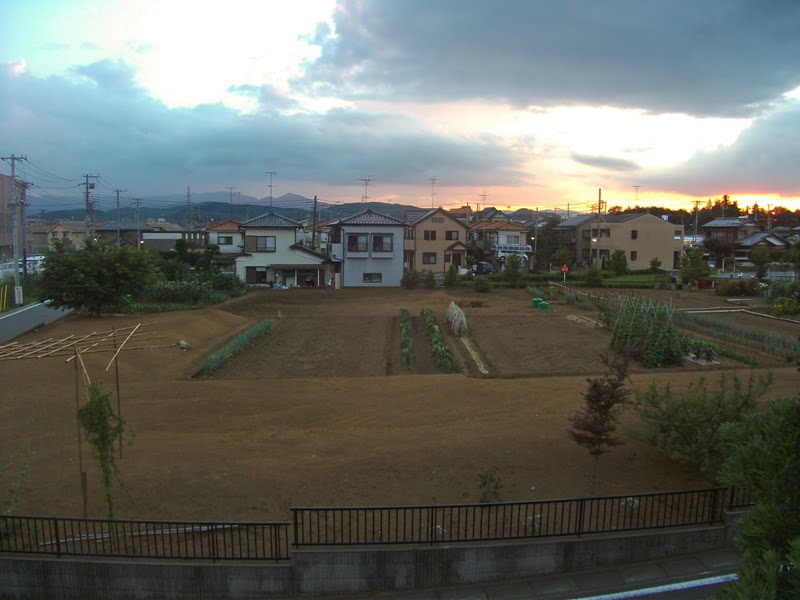
Welcome to Namegawa.  It's a small, laidback town that lies about 40 miles north of Tokyo.  Now, as you perhaps know, being 40 miles away from 'Tokyo' doesn't mean anything, and indeed, I could walk from my house to central Tokyo without leaving an urban area.  But Namegawa sits on the very edge of the city scape, where it bumps into the mountains.  To say it has the best of both worlds is something of a stretch, but there is definitely an element to that.  Because Namegawa's trump card isn't what it has, but where you could be in a very short space of time.

But first things first, Namegawa itself.  It is very much a town of two halves.  In the south, surrounding the train lines, is the built-up area.  Not too built up, though: it's mostly suburbia and some low-rise depots, but it is very pleasant.  The area where I live is especially pleasant, because it is a band new area: even in my short time here, I've noticed at least a couple of dozen new houses sprout up, and one school.  The downside?  There is nothing else here.  Okay, so you've got the train station, supermarket and home centre within easy reach, but by and large it's a largely featureless grid of houses.

To the south, it's very much the 'inaka' (countryside).  The grids of houses give way to grids of paddy fields, with only the occasional wooden house, and the gentle hills are topped with thick mops of trees.  While I wouldn't call the settlements here rundown as such, you definitely wouldn't mistake which area was newer.  It's all very charming in it's own way, but it's remote, and there's not much to pull you out there.  With one very big exception - Shinrin Park.

Shinrin Park is a huge quasi-national park that takes up at least a quarter of the town.  It is huge, full of features too many to count (including a bouncy castle that looks like a weird mountain, but the best thing about it is the sprawling network of cycle lanes, running through the park like a web of mini-roads just for bikes, and my word, is it fun.  With friends barrelling along beside you, it's many-times over as entertaining.  Is it worth travelling far and wide for?  Yes.  Absolutely.

There is one more feature to mention of Namegawa (and, sadly, it really is only one more).  That is the observation tower, which sits atop a wooded hill in the middle of the town.  While not as essential a visit as Shinrin Park, it's definitely worth a look if you have the time, especially on a clear day, when the views are spectacular.  You can see all the way from the mountains of Gunma to downtown Tokyo.

Which leads me neatly onto Namegawa's trump card.  You see, Namegawa doesn't really have a lot going for it beyond the basic aspects for getting by.  At night, I despair as I watch my area basically turn into a ghost town.  Seriously, the blackouts that blanketed Japan after the earthquake last year made minimal difference in Namegawa.  There's much to be said for the slow, relaxed pace (indeed, after a hectic weekend, returning here can be a very soothing experience), but as it sits on the edge of the city and countryside, it can't really boast to be either.  What it can boast, however, is insultingly easy access to both.

Hop on a train and you can be in Tokyo in one hour.  Go in the other direction and you can be in Gunma in one hour, too.  And properly big cities and malls lie only half an hour away.  And, if you live in the southern suburbs of Namegawa (which most are likely too), then a train station lies only a 5-10 minute away.  Not many places can boast such a proximity to a train station with a line that can have you in either the urban jungle or, err, rural jungle in no time, and with a low fee to boot.


It's not a perfect town by any means, but I have seen far worse, and when I leave it, I will miss it.  It may be a bit too sleepy and featureless for my liking, but my life in Japan, whatever it will amount to, started here, and it will always be precious to me for that.

Tuesday, 2 August 2011

When the wheels come off

So, as you may have figured out, I'm an Assistant English Teacher in Japan (note the capitals; it's that important, I tell you).  The job has it's ups and downs, it's perks and drawbacks, but the one BIG highlight of the year is the summer holidays, which I get off (not all English teachers here get that luxury, but it's usually a trade-off between pay and free time, so it all evens out in the end).

I had planned to return to the UK for 3 weeks this summer, but after a furious reshuffling, I'm now staying here, with a trip to Korea as the big feature of this summer break.  But that's not all!  Ooh, no.  Tomorrow morning (and it's the nasty end of the morning - I'm up at 4am to catch trains, ugh), I'm off on a trip to Nagoya and Hiroshima, taking in other various places on the way, including one of Japan's most famous sights - so watch this space!

Mike the Bike really stood out in a crowd.
Even my days of rest between Karuizawa and this have been packed with stuff, planned or spontaneous.  Last weekend, not long after my last blog post, I was halfway to cycling to Cainz Home when my (t)rusty old bike gave up on me (Mike, I called him.  Mike the Bike.  Okay, stop the sniggering at the back): the back wheel buckled, well beyond repair.  I nursed the poor thing back to D2, where I bought him 16 months ago*, and I bought my nigh-identical replacement.  Spike, he's called.  Well, I couldn't think of any other names that rhymed with bike.

It's a good thing too: just that night I was halfway through cooking when I realised I was missing a vital ingredient.  You have never seen a guy hustle a bike through Japanese suburbia so fast.  To Yaoko and back in under 10 minutes.  Which was just as well: moments later the Mother Of All Storms rolled over, with lightning breaking more frequently than a card castle on a bouncy castle.  One lick of lightning struck either ridiculously close to my apartment or the building itself: no gap to speak of between the lightning, the thunder...and the power cutting off for a good half hour.

But the night wasn't finished yet.  Oh no.  Not to be outdone by the sky, the earth wanted to get in on the action too, and at 4am I awoke to my apartment shuddering at a 6.4 magnitude earthquake.  Phew.

A chance to really break Spike in came on Monday, when my friend Marcos and his visiting friend from Miami, Tanya, came to visit, specifically to take a bike-ride around the wonderful Shinrin Koen.  Shinrin Koen is huge national park near my house, and it's big selling point (for me, anyway) is the network of dedicated bicycle-roads throughout the park.  It was especially fun to be weaving through the rapidly darkening trees to reach the exit before closing time: we were sure we wouldn't be closed in, but it sure was a good motivator.  Trouble was, I'd bought my own bike, so even aftet we'd left the park I had to push-pedal my way another 4km home.  Needless to say, when I got back a shower was in order!  The izakaya food, drinking and karaoke were an excellent way to unwind afterwards too.

So, here I am.  Time to turn in and a few precious hours sleep.  Here's hoping nothing disturbs that...

See you in a few days!

*Yeah, 16 months isn't that long, I know, but I used my bike every single workday, for at least 8km.  I figured that I did around 1,900 miles on my old bike, roughly the same distance between Sierra Leone in Africa and the tip of Brazil.  A little a day sure adds up, doesn't it?  Not that 8km a day in the sweltering Japanese summer felt like small fry, ooh no.

Wednesday, 27 July 2011

Creatures of the Night

Well.  If there's one absolute truth about Japan, it's that everyday brings a new experience worth talking about.  My trip to Karuizawa with my girlfriend was no exception.

First, a bit of background info: Karuizawa is a town that sits high in the mountains straddling the valleys of Nagano and Gunma, and as such is styled as an alpine town, complete with ski slopes, sports outlets and faux wooden lodges.  Make no mistake, though: Karuizawa is an all-year-round resort (a fun fact for you: Karuizawa is the only place in the world to have hosted events for both the summer and winter olympics); indeed, the high altitude makes it a refreshingly cool escape from the baking heat of the lowlands in the summer.


We checked in at a delightful Pension (ペンション、taken from the european meaning of the word, which is similar to B&B), called the Castille.  When we were deciding on places to stay, this one had the clincher for me: it had cats.  Lots of them.  Any one who knows me knows that I have an unhealthy obsession with cats, and as soon as we checked in I made it my personal mission to track down and harass each and every one of the hapless creatures.  The downside?  On the second night we awoke at some ungodly hour to the caterwauls of an all-out catfight.  I waited for one of the staff to go out and break it up (surely it had to be common enough for it be someone's job?) but no.  Clearly, 我慢 ('gaman', bascially putting up with it) was in full force, and the yowling went on unhindered for about 15 minutes before I had enough and went out sort it out myself.  I imagine the image of me blundering down a moonlit Japanese backstreet in my PJs and flailing my arms wildly at retreating cats must have been a sight to see, but it worked, and I got a few more hours precious rest.  The next morning I awoke grogilly to see the culprit cat sunning itself on the terrace.  I ate my jam on toast giving while giving it bleary, evil stares.

The full day in Karuizawa was bliss.  We rented bicycles and rolled our way to Kumoba pond, a lovely little place that can be walked around in half an hour.  We saw huge koi fish and indigo butterflies as big as your hand.  Then it was onto Kyu-Karuizawa (Old-Karuizawa), the centrepiece of which is a street called Ginza-dori (Ginza-street, so-called because of it's resemblance to the trendy Ginza district in Tokyo), and we spent the day drinking in the various shops of trinkets, confectionery and more jam you will ever see in your life (Jam is Karuizawa's specialty).  I left with a Totoro banner and a pair of chopsticks with my name printed on them.

That evening, my girlfriend and I decided to splash out on a proper, fancy meal (not what you see in the photo, though that was just as lovely).  Thanks to the unsettled weather we decided to take a shortcut to the restaurant.  Bad idea.  The back road took us through an unlit stretch of dark, damp forest.

Twice we sped up our walking: the sound of something very big crashing through the trees towards us, what I could only take to be a wolf walking RIGHT UP TO US.  I hope you can understand that I don't have any photographic evidence of this encounter, but still...it couldn't be a wolf, could it?  They've been extinct in the wild in Japan for over 100 years.  No, this had to be a dog.  A...a wild-looking dog that had emerged from the forest, with no houses in sight... I tried to play the role of brave man as my girlfriend was understandably terrified (note to readers: the shortcut was HER idea!), but to be honest, I was scared too.  It seems stupid now, I know, but in the dead of night, on an empty, misty road, it all seemed so much more menacing.  Still, the dog-wolf-thing passed us by after giving us a long, hard look, and we quick-footed it towards the inviting, warm lights of the restaurant.  Needless to say, it was the best thing I'd ever tasted.

Friday, 22 July 2011

The Nihongo Lingo

Hello, my name is Peter Leonard, and I'm an addict.  Seriously.  I'm addicted to the Japanese written language.  Honto ni.  Maji de.  For real.

For those who aren't familiar with it, the Japanese writing system has three elements: hiragana (ひらがな), katakana (カタカナ) and kanji (漢字).  Hiragana is used mainly for grammatical points and is used by beginners and veterans alike for 'spelling out' difficult kanji (for example, 美味しい, 'delicious', is often written in it's hiragana form, おいしい).  Katakana is used mainly for loanwards from other languages, usually English, taking the nearest sounding sounds in the Japanese system to make the 'Japanized' word, to often comical effect (some are straightforward: アメリカ, reads as 'A-ME-RI-KA' which is of course 'America', whereas マンション, 'MA-N-SHO-N', isn't 'Mansion' at all, but an apartment).

But these two alphabets are a mere pittance compared to Kanji, the meat and potatoes of the Japanese language.  Hiragana and Katakana each has 46 symbols (sometimes Katakana has 45, depends who you ask).  Sounds like a lot?  What if I told you that there are 2,000 Kanji you need to know just to get by?

I'll always remember when I took my first proper lesson with Kanji a few years ago.  Every single one of them looked like an impossible snarl of jumbled up lines.  'How on earth am I going to get to grips with these?' I thought.

But here's the thing: learning Kanji is FUN.  It's a journey of discovery.  Each one is, essentially, a little picture, with it's own story behind it.  Over time, you'll see patterns; recurring elements in the Kanji that help you get the 'feel' of it's meaning.  Take 浅 and 湯, for example.  Notice that they both have three little strokes to their left.  It means 'water', and you can see that they look like little splashes.  These Kanji mean 'shallow' and 'hot water' respectively, both with a watery meaning.

To be honest with myself, I have a twisted sense of fun.  Looking for stories in thousands of little symbols is maybe your idea of torture.  It gets even more compliated when you find out each one has at least two different meanings and readings, with no real rules to follow.  But living in Japan gives learning Kanji a real sense of progress.  For every one you learn, life in Japan becomes that little bit richer.  The same goes for the spoken word too: it's a curious fact of learning a foreign language in it's native country that, as soon as you learn a word or phrase, it's only a matter of time before you hear it amongst a thronging crowd or read it on a billboard.

So yes, I'm an addict of this ridiculous, complicated and strangely moreish language.  Just like when kids won't stop talking and reading everything they can when they learn how to, I also drink up all the information I can find.  Paradoxically, fluency is what I'm both aiming for and yet dreading: I'm going to miss this sense of newness and interest in everything I see.  Still, with a language this crazy, that won't be any time soon.

Thursday, 21 July 2011

"Why did you come to Japan?"

As a foreign resident in Japan, I'm often asked this. The answer is both simple and complicated: put simply, I love Japan.

Sigh, I hear you, er, sigh. A blogger confessing their love for the country they're in. What else is new? Well, maybe nothing, but the thing is, I have no idea WHY I love Japan so much, and I fear it might be a slightly masochistic love affair. And this is where it get's complicated, folks.


Firstly, Japan isn't really a conventional country to 'escape' to, is it? True, their impact on pop culture and modern life can't be denied: from Sony to Nintendo; Nissan to Kodak; Manga to Anime: these are words anyone with even half a finger on the pulse of today's world will recognise. But these are things you can experience and absorb quite happily in your own country, as authentic or not as you please, with the peace of mind that when you step out of the door that the signs are still in a language you know. You don't really need to move to Japan to immerse yourself in an Otaku lifestyle, not really.

So no, Japan isn't an 'escape' country. For the most part, Japan is a working, modern and often stressful place to live, and more often than not it resembles every other first world country out there. And let's get one thing straight; for all of it's much vaunted advancements and trumped cleverness, Japan is not the uber-space-age-techno-land you might expect. Oh sure, there are great dollops of fantastic neon-lit futurism to be savoured, no doubt, yet for all of it's dynanism, Japan can be frustratingly backward and slow-moving in other respects. Those used to going light and paying with everything by plastic will be shocked to find that Japan is still a cash-heavy culture, and TV ads are only just starting to push ATMs like they are new things.

And for all the complaints we might level at the quality of our own television, you'll be sorely missing them when you witness Japanese TV: garish game-shows, cheesy daytime TV dramas and SO! MANY! ADVERTS! (Sometimes entire shows are just whole adverts for products - a critique that could be levelled at our own TV sometimes but in Japan it's so in-your-face it actually causes a headache).

How about the traditional Japan, then? True, their history and culture is enigmatic and deep, and I love exploring temple sites and shinto shrines. But again, this is holiday material. You don't move to a country for the history, because annoying functional necessities like buying the milk get in the way.

Japan isn't even really an especially pretty country. Oh sure, the national parks and mountains are beautiful (aren't they always?), and the night-time bright lights of the big cities hold their own appeal, but the majority of urban Japan is surprisingly scruffy: the lack of wire-grounding means that telephone poles are often choked with wires that web thickly overhead, often ruining views, and when looking out from a train window at a suburb, it may just surprise you just how strikingly similar some of the tightly-packed houses look to a shanty town (they're not, of course, but on first glance it may take you back).

And yet...yet...despite ALL this, despite all of the frustrations, contradictions and everything else, in Japan it all works. Somehow, all of these ill-fitting pieces come together to form a truly alluring, unique mosaic of culture and society that I just couldn't (and still can't) describe in mere words. Returning home from the eye-burning experience of Akihabara, with it's neck-straining heights and endless floors of electronic delights and stomach-churning colour clashes as capitalism rides high, to return to the quiet back streets, quaint and old-fashioned somehow yet clean and entirely modern, to slip off your shoes as you enter and watch from the back door as birds rest on the reams of overhead wires and children make their way home in their strange uniforms, to when the sun sets and Japan lights up like a beacon from space, knowing the night's entertainment, whether out and about or at home in front of the box, is brainless and daft but a light and undemanding way to unwind after the long days many work. This, and everything else, is all at work in everyday life, new and old, forward-facing and backward-looking, sophisticated and intelligent yet childlike and MASSIVE on kawaii-culture (more on this some other time)...Japan presents itself from many angles at once, and it's contradictions make it a fascinating place.


When the Japanese talk about their own uniqueness as a race there's more than a shade of arrogance and naivety to it, but I'll tell you what, there's a fair chunk of truth to it too. Like all the best love attractions, I guess, you have no idea why you love it, you just do, for many reasons and yet no real reason at all.

So this is the aim of my blog, 'Breaking Japan'. To try and make sense of this confounding, enigmatic country, and report it back. All of it: the good, the bad, and the downright bizarre.